Flexible Work Schedule that Maximises Profits


Flexible schedules are on the rise. More companies are looking into accommodating flexibility in the workplace that promise a greater lifestyle and work-life balance. How does one maximise profits while still retaining a flexible schedule? The short answer is that when employees are happy, they tend to work with greater efficiency, and what comes after efficiency is shorter hours to complete work, in return more profits from getting more work done.

If you are looking to hop on the bandwagon, you came to the right place. Due to the flexible nature, not all work schedules are suitable for every company, as it depends on the industry and nature of the business, here are some of the most comprehensive flexible work schedules that you could implement in your company.

6 On 2 Off Shift Schedule
A relatively slow rotating shift pattern that uses 4 teams and three 8-hr shifts to provide 24/7 coverage.

Set-up guide:
1. Requires 4 teams
2. Each team rotates through the following sequence every 24 days: 6-day shifts, 2 days off, 6 swing shifts, 2 days off, 6-night shifts, 2 days off
3. Average 42 hours per week per personnel

8 Plus 12 Shift Schedule
A fast rotation shift pattern that uses 4 teams to provide around 24/7 operation and it is popular for security service firms, military units and operations that require 12-hr weekend shifts.

Set-up guide:
1. Comprises of 4 teams
2. Combination of three 8-hr shifts on weekdays and two 12-hr shifts on weekends to provide 24/7 coverage
3. Each team rotates through the following shift sequence over 4 weeks
4. Repeat cycle of 28 days
5. 42 average hours per week

2-2 3-2 2-3 Rotating Shift Schedule
A rotating shift schedule comprises 4 teams and two 12 -hour shifts to provide 24/7 coverage.

Set-up guide:
1. 4 weeks or 28 days cycle
2. Each team works 2 consecutive day shifts, followed by 2 days off duty, works 3 consecutive day shifts, followed by 2 days off duty, works 2 consecutive day shifts, followed by 3 days off duty, 2 consecutive night shifts, followed by 2 days off duty, works 3 consecutive night shifts, followed by 2 days off duty, works 2 consecutive night shifts, followed by 3 days off duty
3. Average 42 hours per week per person

6-4 6-4 6-4 Ten-Hour Rotating Shift Schedule
A rotating shift uses 5 teams and 3 overlapping ten-hour shifts to provide 24/7 coverage.

Set-up guide:
1. 30-day cycle
2. This plan requires 5 teams with a minimum of 5 employees with 3 teams on duty and 2 teams off at any given day
3. Each team works the first six consecutive 10-hour shifts, followed by 4 days off duty, works the third six consecutive 10-hour shifts, followed by 4 days off duty, works the second six consecutive 10-hour shifts, followed by 4 days off duty
4. The overlapping shifts provide extra manpower during high activity periods
5. Average of 42 hours per week

Couldn’t find what you're looking for? Or do you have special needs for your work schedule? To save yourself from all the hassle, you could choose to adopt a Time & Attendance System for your company and leave the work schedule to the experts. On top of that, a Time & Attendance System could also offer greater time management for employees, it also presents more clocking options and features like:


Real-Time Data  

Clock-In/Out with Smartphones 

Employee GPS Clocking
 

Distance Calculator 


Data Consolidation From Different Locations
 

Notifications for Tardiness & Absenteeism
 

Overnight Shift Scheduling
 

OT Application & Approval


03-8070 9933     |     Email     |     www.timeteccloud.com     |     Interest Form

Efficient Work Schedule to Maximise Profits (Fixed Schedule)


Time spent on work is equivalent to profit, and to generate the most out of it, the answer is obvious, optimising the work schedule is the key to improving the company's efficiency and thus maximising profits but with various available work schedules, one might wonder which is the most suitable and yield the best results. We hate to break it to you, but there is no “holy grail schedule”, as it all comes down to the industry and nature of the business, here are some of the most comprehensive fixed work schedules that you could work around.

9 to 5 Work Schedule (Weekend Off)
To start things off with the obvious but widely used, the standard work schedule for office workers and non-shiftwork operations starts at 9 am and finishes at 5 pm.

Set-up guide:

1. 8 hours per day, 5 days a week
2. Repeat Cycle of 7 days
3. Average 40 hours per week
4. Weekends off


4/10 Compressed Work Schedule
Schedule for staff working 10 hours for 4 days a week. The idea is to offer an alternative to an 8-5 or a 9-6 schedule for companies or government agencies that are offering longer service hours for example 7 am to 7 pm to clients with the opportunity to achieve work-life balance for employees.

Set-up guide:

1. Cyclical 7 days (Weekly) – Fixed Plan, No Rotation
2. 10 hours daily for 4 days
3. Average 40 hours per week
4. Staff is full from Tuesdays to Thursdays, 50% staff on Mondays and Fridays with Weekends as rest days
5. Need two teams to cover the week with a 3-day weekend every week
 
 
3 Team Fixed 8-Hour Shift Schedule (24/7 Operation)
Schedule that uses 3 teams and 8-hour shifts (day, swing and night shift) to cover 24/7 operations. This is to offer an organisation that has limited staff but needs to provide 24/7 coverage.

Set-up guide:
1. Repeat cycle of 7 days
2. 8 hours per shift
3. Average 56 hours a week
4. 3 teams are required to cover 24/7


Pitman Shift Schedule
Schedule 4 teams and two 12-hr shifts to provide 24/7 coverage. Very popular with police departments, law enforcement agencies, emergency medical services, EMS call centres and dispatchers to achieve 24/7 and provide better work-life balance at the same time.

Set-up guide:
1. 14-day cycle where each team works 2 consecutive shifts, followed by 2 days off duty, works 3 consecutive shifts, followed by 2 days off duty, work 2 consecutive shifts, followed by 3 days off duty
2. Two teams are assigned day shifts while the other two are assigned night shifts.
3. On any given day, one team is on the day shift, one team is on the night shift, and two teams are off duty
4. Personnel are assigned to either day or night shifts for the 2-week cycle and work an average of 42 hours per week

 
Kelly Shift Schedule
The 9-day cycle where teams work 24 hours per shift. This schedule uses three teams and three shifts to provide 24/7 coverage popular with fire departments and emergency services agencies.

Set-up guide:
1. Cyclical 9 days
2. Work 24-hour shift > 24 hours off duty > work 24-hour shift > 24 hours off duty > work a final 24-hour shift > 4 consecutive days off duty
3. Average hours per week is 56
4. This plan requires living quarters for the employees to work and sleep during each 24-hr shift

The options are endless and could be even altered accordingly to cater for the needs of the company. To save yourself from all the hassle of set-up a work schedule, you could choose to adopt a Time & Attendance System for your company and leave the work schedule to the experts. Not only does a Time & Attendance System offer greater time management for employees, but it could also present more clocking options and features like:


Real-Time Data  

Clock-In/Out with Smartphones 

Employee GPS Clocking
 

Distance Calculator 


Data Consolidation From Different Locations
 

Notifications for Tardiness & Absenteeism
 

Overnight Shift Scheduling
 

OT Application & Approval


03-8070 9933     |     Email     |     www.timeteccloud.com     |     Interest Form

Qatar Employment Act

 
Qatar Labour Law Working Hours, Holidays and Leave Information
Qatar Labour Law article consists of a wide range of legal rights guidelines and regulatory obligations for employers and employees to adhere to. This article is constructed based on the Article of Qatar Labour Law to provide a summary and focus information towards the Attendance and Leave aspects.
  
Working Hours (Article 73 of Qatar Labour Law)
Do take note that the time spent for employees to travel for work is not to be considered nor counted into the working hours.
 
 
Break for Meal and Prayer
Similar to the employee’s travelling time, the breaks and interval rest shall not contribute to the total working hours.
 
 
Overtime (Article 74 of Qatar Labour Law)


Rest Day (Article 75 of Qatar Labour Law)

Altho Work is allowed on Rest Day (if not going on for 2 weeks or more consecutively), do note that there is compensation in the form of 2 choices:
i) 1 rest day to replace on another day along with payable wage of the regular working hours wage
ii) Paid with regular hours wage plus a minimum 50% of the regular hours' wage


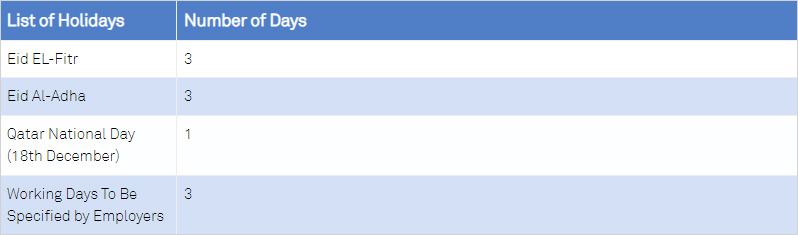
Public Holiday (Article 78 of Qatar Labour Law)
Employees are entitled to the following public holidays with remuneration paid in full.


Annual Leave (Article 79 and Article 80 of Qatar Labour Law)


Employees are entitled to a leave for fractions of the year in proportion to the service period.

The employer has the right to determine employees' annual leave in the form of 3 choices below:
i) Set the dates for employees’ annual leave.
ii) Divide the leave into a maximum of 2 periods with the respective employee's consent.
iii) Provided with a written application to the employees to postpone no more than 50% of the annual leave to the following years of its entitlement.
 
Sick Leave (Article 82 of Qatar Labour Law)
Employees who completed 3 months of service with the employer are entitled to paid sick leave yearly for their service. 


The employer has the choice to terminate the employment of the employee that has extended 12 weeks of sick leave if proven unable to return to work due to the reason of sickness. However, if an employee is entitled to sick leave with pay and resigns due to the reason of sickness before the end of the 6 weeks, the employer is required to pay the balance entitlement of the sick leave to the employee..


Pilgrimage Leave (Article 83 of Qatar Labour Law)
Muslim employees are entitled to have Pilgrimage Leave throughout their service period. The employer may determine the number of employees who are entitled to this leave annually and give priority to the longer-service employees. 
 
 
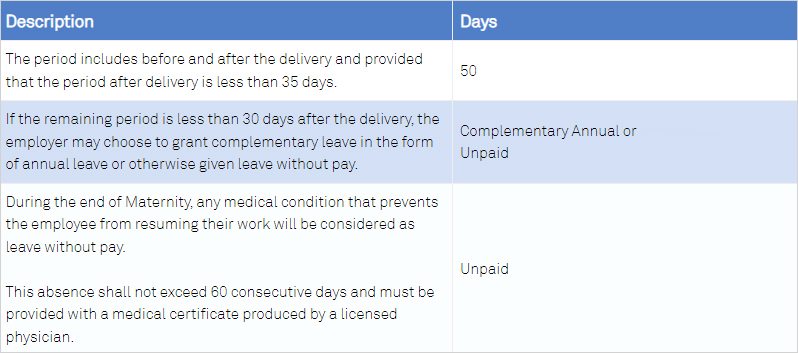
Maternity Leave (Articles 96 & 97 of Qatar Labour Law)
Maternity leave is only entitled to female employees that had completed at least a year of service to the employer. 
 
Nursing Break for Mothers Art 
*Disclaimer: The above article is meant for general information only and is not intended to be used as legal advice. TimeTec has no obligation or responsibility concerning any actions taken based on the provided information.
 
Look no further as TimeTec offers hassle-free solutions for your HR administrative processes. Contact our exclusive distributor in Qatar, Intelligent Project (FingerTec Qatar) at +974 44294833 , +974 70011220 or salesadmin@iprotek.com for demo and consultation.
 
03-8070 9933     |     Email     |     www.timeteccloud.com     |     Interest Form
 

Malaysia Employment Act Amendment (Year 2022)


The Employment (Amendment) Act 2022 under labour law of Malaysia has included a sequence of adjustment from the Employment Act 1955. As an employer and HR, it is essential to keep track of such regulations that will affect the company operation and workforce planning. In this article, we have summarised some of the amendments in relation to Time and Attendance and Employee Leave Management.
 
Employee Working Hours 


In regards to the Amendment Act 2022 of reducing the maximum working hours per week to 45 hours, employers should also be mindful that the other existing provisions of working hours under Section 60A (1) of Employment Act (EA) 1955 remains.
 
Employee Work Scheduling
Description:
Employee shall not be required under his contract of service to work:

i) More than five consecutive hours without a period of leisure of not less than thirty minutes duration.
ii) More than eight hours in one day.
iii) In excess of a spread over period of ten hours in one day.
iv) [Section 59 (1)] Employees shall be allowed in each week a rest day of one whole day.


Public Holiday and Employee Leaves Entitlement 


Worry about the tracking of your employees working hours and leave entitlement?


TimeTec offers a seamless Cloud-HR Solution to help you achieve hassle-free HR administrative work. Detailed time report generation with multiple efficient clocking methods to help you in maintaining a productive workforce while compliant to the Employment Act.

Join us today and contact us now for a Free Demo. 

*Disclaimer: The above article is meant for general information only and not intended to be used as legal advice. TimeTec has no obligation or responsibility with respect to any actions taken based on the provided information.
 
 
Author:
 
 
03-8070 9933     |     Email     |     www.timeteccloud.com     |     Interest Form

The Rise of Location-Based Super Apps


It is obvious that app development is moving forward from simple to more complex super apps, in a trendier way the app owners like to refer to it as “building an ecosystem”. A super app, once downloaded, stuffs your little mobile screen with plentiful icons, scrollable and expandable with many sub-categories, for example TNG eWallet packed with over 40 main icons; Grab filled with 13 main icons and innumerable promotional and selectable items; and MAE, owned by Maybank, besides its core banking services, lined up with 22 non-banking services including food delivery. No matter how different their inception stories are and how lavish their owner’s background, eventually they have headed almost the same direction and competing in almost the same marketplace.

The Rise of the Super App


For example the Grab app, initially begins from a ride-hailing business, grew multiple tentacles to grab eWallet, food delivery, grocers, finance, insurance services and bill payment, etc.; the Shopee app, started as an eCommerce platform, selling millions of merchandises, marching into eWallet, food and goods delivery, bill payment, etc.; the AirAsia app, from low budget airlines, to food delivery, ride-hailing, hotels, etc.; Pyramid app, a physical shopping mall, extended its services as an eMall, and will soon link to its other township components, to provide a score of online to offline services within its ecosystem. All the super apps, set their primary objectives to enlarge the user base, collect more extensive data for analytics, and ultimately for better monetisation.

Regardless of their origin, whether they are created by a ride-hailing company, or banks, airliners, e-commerce platforms, oil and gas companies, an LRT operator, or a township developer, once the apps started to swell, the services will cross paths with one another. This is something unimaginable in the past, which all different industries set their own boundaries.

Two Camps: Location-Based & Non-Location Based

To ease the comprehension of the super app’s future trend, I divided the super apps into two camps, which are location-based and non-location based. How is it defined whether an App belongs to a location-based camp or a non-location-based camp? Very simple. If the super app centres around its real estate, be it residential, shopping centre, or business tower, it is categorised as a location-based app. The rest, is non-location based.

Most of the popular super apps like Grab, eWallet apps like TnG and Boost, WeChat etc. are non-location based, and Pals for Life for Sunway Shopping Mall, i-City app, 1Utama App etc. are location-based. You may find a huge gap in download rates for these two camps, non-location based easily hit 10 million plus for the download, whereas location-based super apps hardly achieve 100k.

This is not surprising because non-location-based super apps started much earlier and mushroomed in the 4G era, some out of nowhere pop-up as startups, and some are backed by their parent companies as an extension of their current businesses.

5G & IoT Boost Location-based Super App
In contrast to non-location-based, location-based super apps only emerged at a much later stage.

We expect more location-based super apps will surface in the era of 5G due to the booming of IoT. One of the criteria for location-based super apps, is to hook up the users via apps to interact with IoT devices. Why and how?

There are four major categories of IoT devices involved in a location-based app, namely smart parking systems, smart surveillance systems, access control systems and smart office/home systems. All these activities help to improve stickiness, enhance security, smoothen daily operation, and automate building management. For example, for tenant employees that purchase a monthly season pass to enjoy a lower parking fee and simplify the parking access or to get a reserved bay, the integration of the parking system with the location-based app is essential, and for shopping mall apps, besides season parking for merchants, it will extend to include casual parking as well. I foresee larger township development in the future, it is of utmost importance to include a location-based super app as default that carries its branding, and integrates with all types of IoT devices to enhance the connectivity among the users within its community.   

Platform vs Ecosystem
Other criteria to discern location- and non-location-based super apps are simply by their natural build. No matter how super a non-location-based super app is or indulges its users by a myriad of features and items offered to them, it is still a platform to connect merchants from one side, and customers on the other.

Unlike location-based super apps, different operational functions trigger one another for the same user even without any merchant onboard. For example, for a residential super app, a user might be blocked to book a facility slot if they have yet to pay their outstanding maintenance fee. Interactive operation modules within a non-location- based super app form an ecosystem to serve different user groups for its entire community. Different user groups have different rights to access the same or different features.


Near Field Commerce
One thing is for sure, the huge lag in download rates doesn’t matter for location-based super apps because the app is mainly used to serve certain demographic of users around their properties, which are the people that are working, living, shopping, visiting, or adhering to the purposes of the buildings being built, added with extra commercial activities that improve the overall revenues generated by its real-estate related income. Due to the geographical and demographical constraints for the location-based super apps, hence they are hardly competing in the same marketplace with the non-location-based super apps, so there should be no rivalry between the two camps.

Even for commercial module, for location-based super apps, instead of going all out for commercial activities, they will be focused more on near field commerce to add extra sales activities through their apps.

Near Field Commerce represents a certain mix of online and offline operations just like O2O, to connect buyers and sellers but within the same geographical area, which promotes community values, reducing time and cost, cutting waste, and reducing carbon emissions to a minimum.
 
Unlike the non-location-based super apps that emphasise commercial transactions, location-based super apps should treat commercial activities as added value on top of the operational modules in the beginning; and gear up at a later stage for growth and monetisation. More near-field commerce modules can be developed and plugged into the location-based super apps if user-based reaches its critical mass. For examples:

i. Group buy
With multiple purchases and one delivery because the buyers work or live in the same geographical area. 

ii. Yard Sale
To connect sellers and buyers living and working in the same area to sell items to one another without transportation costs.  

iii. Enhanced home service
Plumbing, electrical work etc. can be enhanced with preventive maintenance system.

iv. Advertisement
With data analytics, the ad can be more targeted based on user trackable activities. For example, the loyalty point purchase record to prompt the targeted ad.

When incorporated with commercial modules, location-based super apps should avoid mimicking non-location-based super apps’ business model. Even for shopping mall super apps, the main objective is to lure customers to visit more frequently to their physical malls; selling the merchandise via an app is not a good idea and delivering them to customers miles away is even worse; because it is not worthy if  taking the ROI into account. Instead of going wide, location-based super apps should focus on going deep by tapping on their near field geographical advantage and concentration of users to generate more income from the repeating orders and recurring services. Always remember, as for consumer behavior, they normally tend to spend more around the places that they stay, or work, or frequently visit.

Extensions:
TimeTec Smart Township Ecosystem
The Trend of Malaysia’s Shopping Mall App
Can Housing Developer App Boost Property Sales?

TimeTec smart township ecosystem enriched with its 18 operation and commerce modules as illustrated in the diagram below:


About Author:
Teh Hon Seng, Group CEO of TimeTec Group of Companies. Prior to forming TimeTec, Teh led PUC Founder (MSC) Bhd to be listed on MESDAQ (ACE) market of Bursa Malaysia in 2002. Teh initiated the R&D in fingerprint technology in 2000, which later developed into a renowned global brand for commercial fingerprint product known as FingerTec. In 2008, he foresaw the trend of cloud computing and mobile technology, and over the years, he had strategically diversified and transformed its biometric-focused products into a suite of cloud solutions that aimed at workforce management and security industries including smart communities and digital building system that centered around the cloud ecosystem. Teh has more than 20 patents to his name, and he is also a columnist in a local newspaper and a writer of several books.