Justifying the ROI of a Human Resource Management System


Companies look for substantial Returns on Investment (ROI) from every decision made. That begs the question: Is a Human Resource Management System (HRMS) worth the investment? Is it a cost burden, something good to have or rather a need to have? To demonstrate its true value, here is the breakdown to paint a bigger picture.

We first need to look at the cost of implementing the HRMS. Typically, solutions like these would have monthly subscription costs instead of a lump sum payment. On top of that, if there is specific customisation or hardware needed, there will be additional charges. Depending on the system providers, some may require payment like training, migration and set-up.

There is no way to define the exact ROI, as there isn’t a realistic formula to calculate it. Rather, what’s practical is to look at the aspects that the system will have the most impact on and how these would bring direct/ indirect financial savings.


Extended Processing Time
Let’s be frank, most of the push factors to get the automated system is due to the lengthy processing time that is never-ending. Labour hours are considered as spending, by cutting down the time spent on processing your HR, you are also reducing the cost of staffing. You could save yourself from getting an admin, or free up your HR hands, allowing them to focus on what truly matters, the people.


Avoid Human Errors
Imagine if you are already late for your payroll payment and there is an error due to some input mistakes, we bet you would recoil from the scenario. Mistakes like this not only affect your employees' morale but also consumes unnecessary time to identify and rectify the errors. In the end, all these add up to more labour hours on the payroll processing that could have been avoided by getting an automated system.


Reduce HR Head Count
Due to the nature of the HRMS, you are pretty much running in automation on your HR, letting the system do its job. Instead of getting an HR admin, you could adopt the system at a much more affordable price to run your HR department. We are talking about most aspects that can be automated like Time & Attendance, Leave Management, Payroll & Claim Processing, and more.


Employee Self Service (ESS)
One of the greatest hassles faced by HR is having to answer all questions and requests that could have been done by employees themselves. Such matters alone wouldn’t mean much, but if they were to add up, it could eat up hours each week. By deploying ESS from Human Resource Management System, employees could look for answers on their own and manage their personal information without involving HR in the picture. 


03-8070 9933     |     Email     |     www.timeteccloud.com     |     Interest Form

Save Businesses Money with Time and Attendance System


How can time and attendance save a business money? Putting them together doesn’t make any sense. Once everything has been broken down, the answer is obvious. For most businesses, staffing typically costs the highest in spending, companies are paying employees for their time and attendance, and this is why tackling the biggest issue, is a great way to help companies save money.

 
Eliminate Time Fraud
The greatest “Nemesis” of all time, whether we are looking at an excel sheet or a conventional punch card can be clocked in by just about anyone. All these are risks of ghost workers that put a dent in the companies’ financial well-being. Not to mention, there’s another problem associated with this, buddy punching. Leaving it unchecked would only encourage other employees to join the ‘bandwagon’. Thankfully it all can be regulated simply by implementing biometric devices.


Avoid Human Errors

We are just human, and errors are unavoidable. No matter how cautious we are, sometimes mistakes just slip through the cracks. Small mistakes now and then are still tolerable, but it only takes one huge human error to overturn the whole company into a crisis state. Let’s face it, a crisis doesn’t just cause a company to go haywire, we are talking about actual dollars being spent to neutralise the crisis. Before it turns into an actual problem, you should start working on it, and there is no better way to counter this other than relying on automation offered by the cloud-based time & attendance system. We should let technology do what it does best.


Efficient Reporting

All employees should focus on what truly matters. Instead of wasting effort on time and attendance compilations or tabulations, employees should focus on their actual KPIs. Have you ever thought of how much you’re paying in hidden fees for all this? Your employees could have utilised their time better on tasks that bring ROI to the company. One way to solve it is through the adoption of an attendance system.


Employees’ Accountability

Having a proper attendance system may encourage better employee’ clocking habits. Employees would know exactly when to show up, take their breaks and only leave when the shift has ended. All of these would translate into a more productive workforce and eliminate the problems of short hours or long breaks that would cost the company a fortune.


Improve Employees Morale

When employee morale is high, naturally companies will perform much greater. Simply put happy employees mean a happy company. What comes with it would be greater teamwork, efficiency, and just about everything  To achieve this, companies need to ensure that employees are in shape. If you have to ask, getting that pay cheque in time is one way to do it. A Time & Attendance System alone would be insufficient, it has to be coupled with a holistic Cloud-Based HR System to reap the benefits. How so? Cloud-Based HR Systems can break the barrier between systems and the exchange of information can also be done seamlessly. The Time & Attendance System could transfer all the attendance information to the Payroll System without the need for data compilation. A truly automated system that ensures all pay cheques are delivered on time, without the fear of any unforeseen delay that always results from human errors.

03-8070 9933     |     Email     |     www.timeteccloud.com     |     Interest Form

Flexible Work Schedule that Maximises Profits


Flexible schedules are on the rise. More companies are looking into accommodating flexibility in the workplace that promise a greater lifestyle and work-life balance. How does one maximise profits while still retaining a flexible schedule? The short answer is that when employees are happy, they tend to work with greater efficiency, and what comes after efficiency is shorter hours to complete work, in return more profits from getting more work done.

If you are looking to hop on the bandwagon, you came to the right place. Due to the flexible nature, not all work schedules are suitable for every company, as it depends on the industry and nature of the business, here are some of the most comprehensive flexible work schedules that you could implement in your company.

6 On 2 Off Shift Schedule
A relatively slow rotating shift pattern that uses 4 teams and three 8-hr shifts to provide 24/7 coverage.

Set-up guide:
1. Requires 4 teams
2. Each team rotates through the following sequence every 24 days: 6-day shifts, 2 days off, 6 swing shifts, 2 days off, 6-night shifts, 2 days off
3. Average 42 hours per week per personnel

8 Plus 12 Shift Schedule
A fast rotation shift pattern that uses 4 teams to provide around 24/7 operation and it is popular for security service firms, military units and operations that require 12-hr weekend shifts.

Set-up guide:
1. Comprises of 4 teams
2. Combination of three 8-hr shifts on weekdays and two 12-hr shifts on weekends to provide 24/7 coverage
3. Each team rotates through the following shift sequence over 4 weeks
4. Repeat cycle of 28 days
5. 42 average hours per week

2-2 3-2 2-3 Rotating Shift Schedule
A rotating shift schedule comprises 4 teams and two 12 -hour shifts to provide 24/7 coverage.

Set-up guide:
1. 4 weeks or 28 days cycle
2. Each team works 2 consecutive day shifts, followed by 2 days off duty, works 3 consecutive day shifts, followed by 2 days off duty, works 2 consecutive day shifts, followed by 3 days off duty, 2 consecutive night shifts, followed by 2 days off duty, works 3 consecutive night shifts, followed by 2 days off duty, works 2 consecutive night shifts, followed by 3 days off duty
3. Average 42 hours per week per person

6-4 6-4 6-4 Ten-Hour Rotating Shift Schedule
A rotating shift uses 5 teams and 3 overlapping ten-hour shifts to provide 24/7 coverage.

Set-up guide:
1. 30-day cycle
2. This plan requires 5 teams with a minimum of 5 employees with 3 teams on duty and 2 teams off at any given day
3. Each team works the first six consecutive 10-hour shifts, followed by 4 days off duty, works the third six consecutive 10-hour shifts, followed by 4 days off duty, works the second six consecutive 10-hour shifts, followed by 4 days off duty
4. The overlapping shifts provide extra manpower during high activity periods
5. Average of 42 hours per week

Couldn’t find what you're looking for? Or do you have special needs for your work schedule? To save yourself from all the hassle, you could choose to adopt a Time & Attendance System for your company and leave the work schedule to the experts. On top of that, a Time & Attendance System could also offer greater time management for employees, it also presents more clocking options and features like:


Real-Time Data  

Clock-In/Out with Smartphones 

Employee GPS Clocking
 

Distance Calculator 


Data Consolidation From Different Locations
 

Notifications for Tardiness & Absenteeism
 

Overnight Shift Scheduling
 

OT Application & Approval


03-8070 9933     |     Email     |     www.timeteccloud.com     |     Interest Form

Efficient Work Schedule to Maximise Profits (Fixed Schedule)


Time spent on work is equivalent to profit, and to generate the most out of it, the answer is obvious, optimising the work schedule is the key to improving the company's efficiency and thus maximising profits but with various available work schedules, one might wonder which is the most suitable and yield the best results. We hate to break it to you, but there is no “holy grail schedule”, as it all comes down to the industry and nature of the business, here are some of the most comprehensive fixed work schedules that you could work around.

9 to 5 Work Schedule (Weekend Off)
To start things off with the obvious but widely used, the standard work schedule for office workers and non-shiftwork operations starts at 9 am and finishes at 5 pm.

Set-up guide:

1. 8 hours per day, 5 days a week
2. Repeat Cycle of 7 days
3. Average 40 hours per week
4. Weekends off


4/10 Compressed Work Schedule
Schedule for staff working 10 hours for 4 days a week. The idea is to offer an alternative to an 8-5 or a 9-6 schedule for companies or government agencies that are offering longer service hours for example 7 am to 7 pm to clients with the opportunity to achieve work-life balance for employees.

Set-up guide:

1. Cyclical 7 days (Weekly) – Fixed Plan, No Rotation
2. 10 hours daily for 4 days
3. Average 40 hours per week
4. Staff is full from Tuesdays to Thursdays, 50% staff on Mondays and Fridays with Weekends as rest days
5. Need two teams to cover the week with a 3-day weekend every week
 
 
3 Team Fixed 8-Hour Shift Schedule (24/7 Operation)
Schedule that uses 3 teams and 8-hour shifts (day, swing and night shift) to cover 24/7 operations. This is to offer an organisation that has limited staff but needs to provide 24/7 coverage.

Set-up guide:
1. Repeat cycle of 7 days
2. 8 hours per shift
3. Average 56 hours a week
4. 3 teams are required to cover 24/7


Pitman Shift Schedule
Schedule 4 teams and two 12-hr shifts to provide 24/7 coverage. Very popular with police departments, law enforcement agencies, emergency medical services, EMS call centres and dispatchers to achieve 24/7 and provide better work-life balance at the same time.

Set-up guide:
1. 14-day cycle where each team works 2 consecutive shifts, followed by 2 days off duty, works 3 consecutive shifts, followed by 2 days off duty, work 2 consecutive shifts, followed by 3 days off duty
2. Two teams are assigned day shifts while the other two are assigned night shifts.
3. On any given day, one team is on the day shift, one team is on the night shift, and two teams are off duty
4. Personnel are assigned to either day or night shifts for the 2-week cycle and work an average of 42 hours per week

 
Kelly Shift Schedule
The 9-day cycle where teams work 24 hours per shift. This schedule uses three teams and three shifts to provide 24/7 coverage popular with fire departments and emergency services agencies.

Set-up guide:
1. Cyclical 9 days
2. Work 24-hour shift > 24 hours off duty > work 24-hour shift > 24 hours off duty > work a final 24-hour shift > 4 consecutive days off duty
3. Average hours per week is 56
4. This plan requires living quarters for the employees to work and sleep during each 24-hr shift

The options are endless and could be even altered accordingly to cater for the needs of the company. To save yourself from all the hassle of set-up a work schedule, you could choose to adopt a Time & Attendance System for your company and leave the work schedule to the experts. Not only does a Time & Attendance System offer greater time management for employees, but it could also present more clocking options and features like:


Real-Time Data  

Clock-In/Out with Smartphones 

Employee GPS Clocking
 

Distance Calculator 


Data Consolidation From Different Locations
 

Notifications for Tardiness & Absenteeism
 

Overnight Shift Scheduling
 

OT Application & Approval


03-8070 9933     |     Email     |     www.timeteccloud.com     |     Interest Form

Qatar Employment Act

 
Qatar Labour Law Working Hours, Holidays and Leave Information
Qatar Labour Law article consists of a wide range of legal rights guidelines and regulatory obligations for employers and employees to adhere to. This article is constructed based on the Article of Qatar Labour Law to provide a summary and focus information towards the Attendance and Leave aspects.
  
Working Hours (Article 73 of Qatar Labour Law)
Do take note that the time spent for employees to travel for work is not to be considered nor counted into the working hours.
 
 
Break for Meal and Prayer
Similar to the employee’s travelling time, the breaks and interval rest shall not contribute to the total working hours.
 
 
Overtime (Article 74 of Qatar Labour Law)


Rest Day (Article 75 of Qatar Labour Law)

Altho Work is allowed on Rest Day (if not going on for 2 weeks or more consecutively), do note that there is compensation in the form of 2 choices:
i) 1 rest day to replace on another day along with payable wage of the regular working hours wage
ii) Paid with regular hours wage plus a minimum 50% of the regular hours' wage


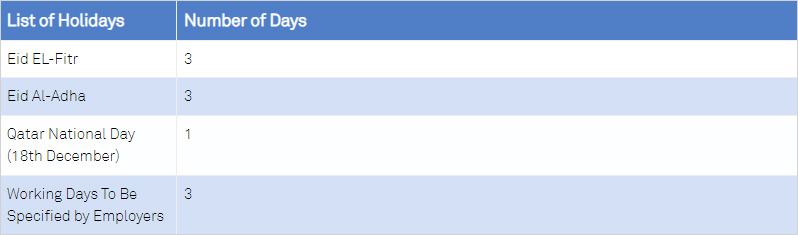
Public Holiday (Article 78 of Qatar Labour Law)
Employees are entitled to the following public holidays with remuneration paid in full.


Annual Leave (Article 79 and Article 80 of Qatar Labour Law)


Employees are entitled to a leave for fractions of the year in proportion to the service period.

The employer has the right to determine employees' annual leave in the form of 3 choices below:
i) Set the dates for employees’ annual leave.
ii) Divide the leave into a maximum of 2 periods with the respective employee's consent.
iii) Provided with a written application to the employees to postpone no more than 50% of the annual leave to the following years of its entitlement.
 
Sick Leave (Article 82 of Qatar Labour Law)
Employees who completed 3 months of service with the employer are entitled to paid sick leave yearly for their service. 


The employer has the choice to terminate the employment of the employee that has extended 12 weeks of sick leave if proven unable to return to work due to the reason of sickness. However, if an employee is entitled to sick leave with pay and resigns due to the reason of sickness before the end of the 6 weeks, the employer is required to pay the balance entitlement of the sick leave to the employee..


Pilgrimage Leave (Article 83 of Qatar Labour Law)
Muslim employees are entitled to have Pilgrimage Leave throughout their service period. The employer may determine the number of employees who are entitled to this leave annually and give priority to the longer-service employees. 
 
 
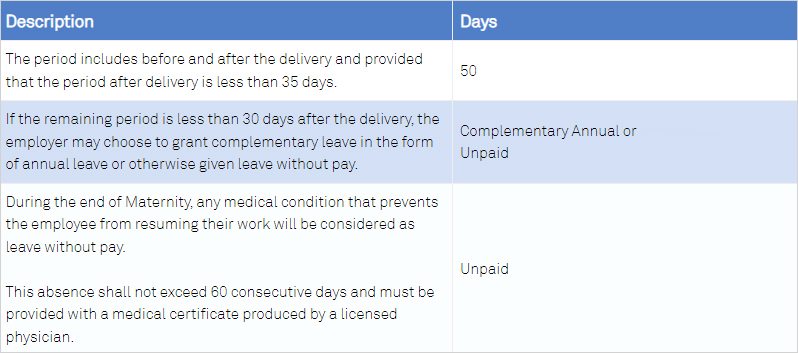
Maternity Leave (Articles 96 & 97 of Qatar Labour Law)
Maternity leave is only entitled to female employees that had completed at least a year of service to the employer. 
 
Nursing Break for Mothers Art 
*Disclaimer: The above article is meant for general information only and is not intended to be used as legal advice. TimeTec has no obligation or responsibility concerning any actions taken based on the provided information.
 
Look no further as TimeTec offers hassle-free solutions for your HR administrative processes. Contact our exclusive distributor in Qatar, Intelligent Project (FingerTec Qatar) at +974 44294833 , +974 70011220 or salesadmin@iprotek.com for demo and consultation.
 
03-8070 9933     |     Email     |     www.timeteccloud.com     |     Interest Form